
Against Certainty
An interview with poet, Scott Cairns

Dear friends,
What is meaning-making in poetry? And how does it differ from a poem as something “of meaning made”? How can humor, faith, and the ultimate hope in “apocatastasis, that final restoration of all things,” work its way into your bones through a particular set of poems or most of all, through life itself?
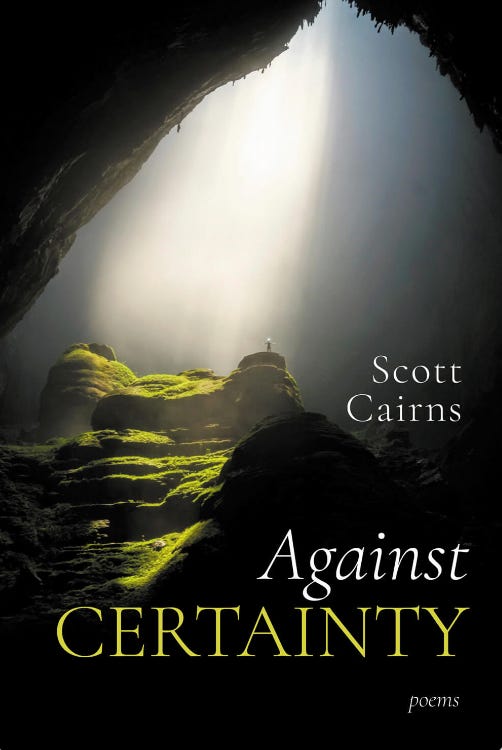
Today, I’m touched to share answers to these questions and more with poet, friend, and brother-in-Christ, Scott Cairns. His newest collection of poems, Against Certainty, releases with Slant Books next month (and is available for pre-order now). Read on for a heartfelt conversation (and check out his other work mentioned in the piece, as well).
As always, thank you for reading.
In Christ,
Brandi
BWS: This new collection of poetry, Against Certainty, culminates “forty years of literary pilgrimage,” and reinforces the idea you often write about, which is that a poem is a “scene of meaning-making,” rather than “a document of meaning made.”
I’m going to refer to this idea of meaning-making in some subsequent questions, so would you mind beginning with me by talking a little bit about the difference between these two ideas, especially for people who may be new to reading poetry and might have assumptions about what a poem is?
SC: Thank you, Brandi! Yes, in my mind, this distinction is what sets a poetic text—actually, any genuinely literary text—apart from all other forms of writing. Generally speaking, when a reader takes up a text and focuses primarily on what an author has expressed, the text in hand becomes in that way limited to serving as the delivery system for a prior event—an idea or emotion that the author had, an experience that the author suffered or enjoyed, or an opinion or argument that the author hopes to distribute to the rest of us. The act of reading this way assures that the energy expended is necessarily done so as a retrospective activity.
Conversely, when a reader approaches a given text as a scene of meaning-making, the page is more appropriately understood to be a meeting place, and the meaning one perceives is more nearly the result of a collaboration—not so much a collaboration between the reader and the author, but more a collaboration between the reader and the text in hand. The act of our reading this way educes from us what is in us even as we attend to what the author has provided to the page, and it allows our engaging in a more prospective activity.
The first disposition focuses on the past; the second and more efficacious disposition focuses on the present, and generates a future.
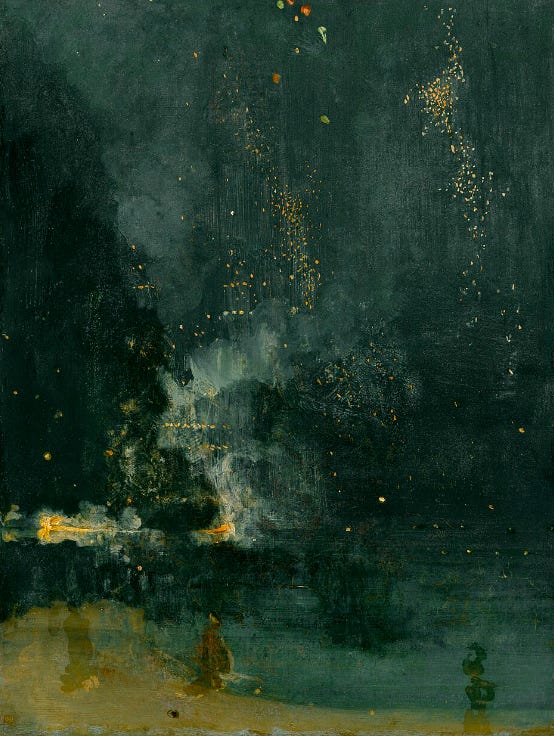
BWS: Thank you for that clarification! I want to begin discussing some of your specific poems with, “A Mystical Poetics,” in which you write about a moment at your “parents’ modest house” when you were looking out at winter night’s sky. In that moment, you write, you looked out at the “dazzling heavens” and received “the music of their joy.” And you said:
“I love life – a child’s
naïve sentiment sent out into a cold
and dark surround.”
I paused at those words because I have done the same thing, saying aloud, “I love life!” And that moment in the poem reminded me of Christ’s reminder for us to be childlike, to protect childlike faith, and to enter into it (Matthew 18:4). “Since then,” you finish the poem,
“the limen
has continued to appear as a thin
and permeable membrane for the mind’s
noetic reach, the heart’s voracious wish.”1
I read and have reread this poem many times, and Scott, I think it might be my personal favorite in this collection. I am no mystic, but poetry – and childlike experiences – helps me at least glimpse that “bigger picture” you reference in the poem.
Have you had other moments since then of “childlike” proclamations of faith?
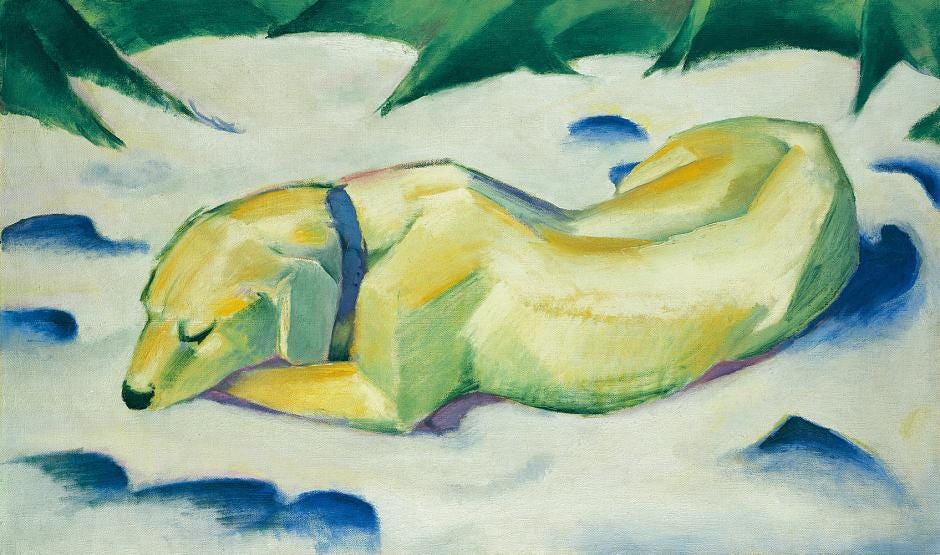
SC: Yes, I would have to say that they are fairly common to me, and have been so, for a good long while. I believe that this first conscious experience on my parents’ threshold has continued to color much of how I have seen, received, and responded to the manifold beauties that have surrounded me, that surround me still. The people I love, a lifetime of wonderful dogs, every visit to the forest or the shore—all of these, duly attended, have tended to dash my abstractions, my occasional disappointments, my anxieties to the ground. They ground me in mercy and beauty, and what I hear internally is a resounding, deep, bass note of joy.
“The people I love, a lifetime of wonderful dogs, every visit to the forest or the shore—all of these, duly attended, have tended to dash my abstractions, my occasional disappointments, my anxieties to the ground. They ground me in mercy and beauty …”
BWS. I also I loved your opening poem to the collection, “Just as an Archeologist …,” in which you engage with Auden’s poem, “Archeology.”
In your poem, you write,
“The very words I utter have a way
To implicate a glimpse of what to say …
For all I know, the Word Himself provides
Each word with lit, regenerative life.”2
A whole theology, I think, is expressed in those last two lines of yours. You are writing about the similarities between being a poet and an archeologist and what might be unearthed or glimpsed in the work, but you’re also hinting at something greater, I think: that big “for all we know” when it comes to faith. For all I know, the Holy Spirit is working within or through me whenever I try to write, or make, or do something that expresses Goodness, Truth, and Beauty … For all I know, it’s His work, and not mine.
Can you talk a little bit about the work of the poet, perhaps as an archeologist of words (or meaning-making!), but also about the work of the reader, who is “delving” into the work as he or she reads, too?
SC: As you may know, over the past thirty-six years I have served as director of a couple Ph.D. programs (University of North Texas and University of Missouri) and a couple M.F.A. programs (Old Dominion University and Seattle Pacific University). During that time, I made certain that our foreign language requirements remained intact, despite the nearly annual attempts by students and some faculty to remove those requirements in order to facilitate admissions and to move students more quickly through those programs. The argument generally went like so: “Two or three or four years of a foreign language will not be enough to produce fluency in that second or third language.” That’s probably true for many students (not all), but fluency is also not actually the point.
The English language is something of a museum of words, the result of Greek and Latin and other influences; English words are, in general, haunted by the ghosts of their etymological ancestors. The bottom line is that if you want to know your own language, if you want to become a genuinely accomplished writer of literary texts, you must become sensitive to and aware of the connotative reach of the Greek- or Latin-haunted word. As a writer, you can bring profound suggestiveness to bear upon your written work; as a reader, you can savor the subtle implications that are latent in every text you pore over. Meaning-making from both of these positions is deeply enhanced by the inter-linguistic conversation that occurs in the imagination of a duly equipped reader and writer. Poring over and delving into the etymologies of the English words we employ might be likened to a delicious form of archaeology, no?
BWS: I absolutely agree, speaking as someone with a poorly-used Spanish minor here! I am not fluent, but studying Spanish attuned me to the music of other language, gave me insights into shared musicalities and histories of meaning. It is indeed delicious!
In addition to referencing the Greek language in your poetry, you often write or reference the nous, as well, and that’s not something with which I think a lot of readers are familiar, especially outside the Orthodox Faith. Would you mind talking a little bit about the nous – what it is, what it means – for those unfamiliar with the term?
SC: I suppose that one of my purposes in employing in my work the untranslated Greek word, nous (νους), is primarily to recuperate the term, to rescue it from translations that have diminished its significance. In most English translations of the New Testament, for instance, “mind” or “reason” have become overly simplified replacements for what is a very complex—and by no means a simply intellectual—gesture. The late and brilliant Bishop Kallistos Ware indicated an efficacious bridging of mind and body when he characterized nous as “the intellective aptitude of the heart,” indicating the word’s gesture as an intuitive power. It might be said that the regrettable reduction of faith itself to being a merely intellectual acquisition has come about as a result of simplistic translation. The worst result has been to allow Christians to imagine that their faith is simply a good idea, and not a necessarily embodied practice.
In truth, the nous is a spiritual faculty that, duly cleansed, avails for us a felt communion with the God who loves us, even as it serves as a spiritual faculty that can occasion a felt communion with other people, the very Body of Christ.
A discipline of prayer is the sole means by which a clouded or flawed nous can be restored to its efficacious purpose, enabling communion with God and with others.
BWS: Recently someone asked me to explain a phrase heard sometimes in the Orthodox Church: a “bright sadness.” It was coined by Fr. Alexander Schmemann, of blessed memory, in his book, Great Lent: Journey to Pascha.
“Bright sadness” describes this feeling and state in which we live (especially during Great Lent) that Christ’s betrayal, crucifixion, and death is the saddest, most awful, most horrible thing that ever happened, but also that it’s the most beautiful and redeeming thing because it means that death is defeated, trampled down. It also describes our state, in the revelation and reality of God’s great love to us.
I was (trying) to explain that during Great Lent, and in particular those intense days leading up to Holy Week and Great and Holy Pascha, we experience both feelings of crushing sorrow and redeeming joy at the same time; it’s a paradox.
And I have to admit that while I was reading a lot of your poems in this collection, I felt something similar: there’s a “bright sadness” to your poems, a space in which you stand that is a real rough struggle. Ultimately, however, your words turn – your position conveys hope – because of faith. “[T]hat from this ice I might yet build a dome,” as you write in the final line of “Chemo with Coleridge.”3
Would you talk a little bit about your experience writing and reading through difficulty, as you do in this collection?
SC: I’m not really sure that I can, but I will try. I suppose that the diagnosis of my having an incurable blood cancer began what seems to be my life’s Lenten season. Among other things, like Lent, this season has become a time of repentance, and, as such, a time of hope, of joyful anticipation. Orthodoxy has taught me, albeit slowly, that repentance itself is something of a paradox; it is an undertaking in which the sadness of my missing the mark is palpably accompanied by the joy of forgiveness. Similarly, the profound sadness I feel as I anticipate my leaving the persons, places, and things I love is attended by a deep note of joy that my eventual departure will not be the end of our story.
The poems in this book and also in my last collection, Correspondence with My Greeks, are, admittedly, much more directly personal than most of my previous collections; I’m guessing that my illness has led to my more willingly and more directly sharing my heart. Since my diagnosis, everything about the world seems more vivid, and I think that my poems of these past few years have been written to more candidly honor the world—those persons, places, things for whom my love has only increased.
“Since my diagnosis, everything about the world seems more vivid, and I think that my poems of these past few years have been written to more candidly honor the world—those persons, places, things for whom my love has only increased.”
BWS: I’d like to talk about this collection of poems in relation to another book you wrote, The End of Suffering: Finding Purpose in Pain (Paraclete Press, 2009). I read that little book a few years ago when I was going through a really rough time. It was so helpful to me because it helped me understand my personal pain in the context of my faith, particularly my Orthodox Faith, and helped me understand (among many things) that my pain was not something separate from God and experienced individually, but something intimately connected to God, and indeed, the entire world. It was not meaningless. It was, to use an earlier term, meaning-making, especially in the light of Christ’s great attention to me.
I found myself drifting back to The End of Suffering while I read the poems in Against Certainty because I felt that your poems were beautiful moments in which poetics referenced your prose. In fact, I really, really encourage people who read Against Certainty to also read The End of Suffering, too.
Has anything you wrote or explored in The End of Suffering changed since writing the poems in Against Certainty? Or you think about that book much as you wrote these poems?
SC: I’m very pleased that book remains on your radar. It remains on mine.
I don’t recall my consciously drawing upon that book and its observations as I was working on these new poems, but, of course, The End of Suffering is the result of my having attended to the matter over many years, so the book’s observations have remained active in my imagination, informing my new constructions. That said, quite a bit has changed, if only concerning, say, degrees of separation; I hadn’t yet been diagnosed. I suppose that the book’s central observation—finding purpose in pain—has become more necessary as the years go by, more essential to finding equanimity while dealing with the challenges of the moment.
BWS: If someone were to ask me, “What makes a Scott Cairn poem?” I would answer: “an ebullient love of poetry, the act of writing poetry, and the recognition we’re trying to write poetry to get at ‘the great mystery;’ a love for the Orthodox Faith; a beautiful and envious Greek scene (or meal); and humor!
I’ve experienced your voice and humor in person (and I’ve also experienced your singing voice in person; be envious, O Reader!). In this collection, there’s a “bright sadness,” but there’s also a “light gladness” (my term) because of your faith, obviously, but also because of your humor. Here are just a few lines from poems that actually explore some pretty big concepts or moments, but were made lighter by your humor:
“I’d often felt chagrined in church – / the church of my youth – as some or other / yahoo at the pulpit spouted nonsense / about … God’s alleged plan for us.” – “Also Not Written” (p. 18)
“What? You had thought creation to be / a one-time act concluded? … Bummer.” – “Creation Without Conclusion” (p. 61)
“Holy, / holy, holy, yo!” – MAKÁRIOS (p. 74)
You can’t read “Holy, holy, holy, yo!” and not laugh. Tell me, what has made you laugh the most recently? And why don’t more poets make us laugh?!
SC: Wow. Thank you for that very generous characterization of my poetry.
Well, thank God, there is a lot going on in my life that makes me happy, that makes me laugh—my wisecracking wife, my pun-addicted adult children, our crazy Labradors. We have a pretty good time most days, especially when our daughter visits from St. Louis, as she did just a few weeks ago.
As for why more poets don’t tend to make us laugh, I couldn’t comment specifically without falling into some species of sin. Maybe, in general, many have yet to discover that the most serious matter is better explored and better understood from a disposition of good humor, high expectations, and a willingness to encounter joy.
BWS: Speaking of other poets, you pay respect to or reference a lot of other folks in this collection, like W. H. Auden, Samuel Taylor Coleridge, Elizabeth Bishop, T.S. Eliot, Pablo Neruda, and Anthony Hecht.
Why these poets? What is it about their words (or lives, if it’s more personal) that resonates with you?
Do you find yourself often returning to a favored poem or collection from these poets?
SC: These poets—and there are a good many others—are the ones I live with. Their collections are stacked on my writing desk. Literally, here on my desk right now I have these poets’ collections sitting in a stack: Coleridge, Auden, Cavafy, Bishop, Dickinson, Rilke, Milosz, Frost, and Stevens; I also have, in the same pile, a fat, bilingual edition of modern and contemporary Greek poets and a giant Greek lexicon. The other poets you mention are readily within reach. These poets have taught me a great deal over the years, and I continue to converse with them on the daily, as we say.
My students know that I depend upon my reading life for my writing life, that I begin each writing session with a reading session, during which I pore of one or another of these poets, alert to my having a new response to a not-so-new gathering of lines. My new response becomes the impetus for that day’s new poem. And yes, each of these poets has a poem or several to which I very often return.
What these poets have in common—it seems to me—is an uncommon attention to the poetic operation of language, which is suggestive and generously connotative language. They don’t write verse anecdotes; they don’t write verse essays; they don’t write verse editorials; they write poems. Each also has a characteristic voice that charms me, and most of them employ a good measure of wit and humor. Their poems light me up, and make me want to light up some pages of my own, but almost always in conversation with them.
BWS: I could keep going with so many other questions and comments, but I want to end with another “returning …” The “returning” you write about in “What Comes Next.”
“Yes, I want to be healed,” you write,
“but more than that
I want very much to see what comes next.”
What comes next, you hope, will include family and friends and “my / beloved dogs – my every loving dog - / leaping once more into my arms,” as well as the embrace of the “One in Whom / … we might yet live.”4
What’s next for you, Scott, – either planned or hoped for – until this beautiful scene takes place?
SC: Well, of course, I do look forward to that apocatastasis, that final restoration of all things. In the meantime, I’m also looking forward to whatever reading gigs—out and about—that the new book will avail for me.
I still work with the Writing Workshops in Greece program, so I look forward to my next trip to Greece and to the Holy Mountain.
In the meantime, I’m still working on poems, and on what I’m calling my verse adaptations of Saint Isaak the Syrian’s homilies.
Mostly, I’m enjoying with my wife Marcia what has turned out to be our apparent retirement as we settle into a new home in Bellingham, Washington, duly accompanied by Ziggy and Zoey, our Labradors.
BWS: What continues to be your “heart’s voracious wish” today?
I wish to know God. I wish to be holy. I wish to assist others to holiness by my having acquired some perceivable degree of goodness.
I have a long way to go.
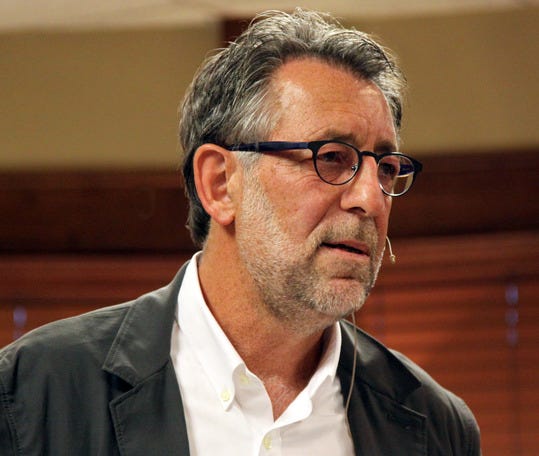
About Scott Cairns
Librettist, essayist, translator, and author of twelve poetry collections, Scott Cairns was Curators’ Distinguished Professor of English at University of Missouri until leaving that position to serve as Director of the Low-Residency MFA Program at Seattle Pacific University. As he oversees that program’s conclusion, he is assisting in its migration to Whitworth University in Spokane.
His poems and essays have appeared in Poetry, Image, Paris Review, The Atlantic Monthly, The New Republic, and many other venues—national and international—and both have been anthologized in multiple editions of Best American Spiritual Writing. He has blogged for the Religion Section of The Huffington Post. His recent books include Lacunae (2023), Anaphora (2019), Slow Pilgrim: The Collected Poems (2015), Idiot Psalms (2014), Short Trip to the Edge (spiritual memoir, 2016), Endless Life (translations and adaptations of Christian mystics, 2014), and a book-length essay, The End of Suffering (2009).
He received a Guggenheim Fellowship in 2006, and the Denise Levertov Award in 2014. His current projects include Descent to the Heart, verse adaptations of selections from the writings of Saint Isaak of Syria, and a new pilgrimage book focusing on Orthodox Christian enclaves in Ireland and Scotland, Holy Outpost: The Thin Place Where East Meets West.
You can read more of his writing here at scottcairns.substack.com.
Did you enjoy this interview with poet, Scott Cairns? If so, please feel free to comment or share this post or more from Writing from the Desert Places.
Scott Cairns, “A Mystical Poetics,” Against Certainty: Poems, Slant Books (2026), p. 8.
p. 2
p. 11
p. 66
Thanks, Brandi, for this touching interview--and the artwork you paired some of the answers with. And thanks to Scott Cairns for the continued labour of love that is his poetry. So much here to ponder and savour, especially the quote about loving life and a lifetime of dogs from his poem about standing on his parents' threshold as a child. I also found myself inwardly applauding at Scott's comments on the role of humour in good poetry (and, imho, theology).
"Maybe, in general, many have yet to discover that the most serious matter is better explored and better understood from a disposition of good humor, high expectations, and a willingness to encounter joy." Yes!!
Brandi, I came across Scott's work many, many years ago and have long admired him from afar. Your interview questions show such curiosity about the writer and clear understanding of his words; they make the interview a true pleasure to read.