
Connection Everywhere
An interview with author, Katherine Bolger Hyde

Dear Friends,
Today I’m so happy to share my interview with Katherine Bolger Hyde, author of The Ghostwriter, forthcoming from Chrism Press this summer. Katherine is an author of children’s books (all of which I heartily recommend) and adult books in a variety of genres. In our conversation below, we discuss a sacramental worldview in writing, how personhood in Christ features in Katherine’s stories, and how she approaches her work, among many other things. Please give it a read and check out Katherine’s books, especially The Ghostwriter, which is available for pre-order now!
I hope you have enjoyed what has become my summer interview series, in which I have shared conversations with authors and poets and introduced you to some of their work or latest releases. This began as an act of literary citizenship and has quickly grown to include several conversations this summer. I have a few more interviews planned this summer or waiting in the wings, but have you enjoyed these conversations? Would you like to see more? If so, please let me know in the comments below or send me a message.
Soon, too, I’ll have my own new release to share with you! After Ancient Faith Kids releases the title and cover this month of my new children’s book, I will follow with an announcement and much more I have created to go along with and celebrate the book. In the meantime, please enjoy my conversation with Katherine Bolger Hyde. As always, thank you for reading.
In Christ,
Brandi
BWS: You are a diverse author, having written contemporary fiction, traditional mysteries, picture books, and middle-grade fiction. And as an Orthodox Christian, you’ve shared that “a sacramental worldview informs everything” you write. Let’s just jump right into the mud puddle! Tell me more about that sacramental worldview and how it appears in your work (and, perhaps, in your life outside your work).
KBH: A sacrament is defined in Orthodoxy as a physical vehicle for the grace of God. The water of baptism, the oil of chrismation and unction, the bread and wine of the Eucharist become imbued with God’s grace and transmitted to us in a way that we can sense if we are attuned to it. Thus a sacramental worldview, in essence, sees everything in creation as being a vehicle for the presence and action of God. What that means for my writing is that nothing is meaningless; every object and event is pregnant with significance, and each is connected to every other, a truth I hint at through my use of metaphor. The spiritual world is not divorced from the material but is embedded in it. Thus it seems natural to me to write about saints, angels, and deceased loved ones interacting with living people.
“[A] sacramental worldview, in essence, sees everything in creation as being a vehicle for the presence and action of God. What that means for my writing is that nothing is meaningless; every object and event is pregnant with significance, and each is connected to every other …”
My life undoubtedly does not reflect this reality as clearly as it ought. I do strive to keep in mind that every person is made in the image of God and deserves to be treated as we would treat Christ. I distrust coincidence and see connections everywhere. And I pursue beauty in all its forms and create it wherever I can.
BWS: We’re living in a world that is identity-rife right now. It seems like the only currency that a lot of society wants to exchange is identity (sexual, marital, religious, political, professional, etc.). In The Ghostwriter, your new release with Chrism Press, you explore how a lifetime of decisions can impact identity: who we are, who we become, but perhaps most importantly, how we view our ourselves. In the case of your two main characters, Margaret and Maeve, how they view themselves – their self-defined identities – isn’t necessarily true, and it causes problems for both of them.
Why was the theme of identity something you wanted to explore in this particular novel? And how does your story relate to identity or personhood found in Christ?
KBH: I’ve actually explored identity in pretty much everything I’ve written, though not often as explicitly as in The Ghostwriter. The great twentieth-century literary critic Northrop Frye wrote, “This story of loss and regaining of identity is, I think, the framework of all literature.” I’ve certainly found that to be true in my own work.
The issue of identity was not at the forefront of my mind when I was working through the idea for The Ghostwriter. The story grew out of my distaste for the whole idea of self-promotion and my wish that I could get someone else to do it for me. My own sister (who is not my twin) is an extrovert to whom that sort of thing comes naturally, so the idea of one twin performing this service for the other grew from that. But as I researched the lives of identical twins, I became fascinated with the whole tension between oneness and twoness that seems to permeate such relationships.
Paradoxically, while one’s identity can become muddled, as Margaret’s does, by trying to fulfill the expectations of other people, the Church teaches us that we can only find our true identity in relationship—to Christ first, and secondly to other people. Only in Christ can we discover the truth of ourselves and view it without despair, because He knows us completely, loves us, and redeems us. Only after grasping that truth can we relate authentically to other people and flesh out our identity in those relationships. I am a Christian, a daughter, a sister, a wife, a mother and grandmother, a friend, a colleague, a member of one particular parish of the Orthodox Church, and each of those relationships contributes something to who I am. We are saved in community; we perish alone.
“[T]he Church teaches us that we can only find our true identity in relationship—to Christ first, and secondly to other people. Only in Christ can we discover the truth of ourselves and view it without despair, because He knows us completely, loves us, and redeems us.”
BWS: Metropolitan Kallistos Ware wrote in The Orthodox Way that if one forgets to find joy in creation, to offer “the world” back to God with thanksgiving, that “I have not yet learnt to be truly human. For it is only through thanksgiving that I can become myself.” I see a lot of that “offering the world back” to God through your children’s picture book writing, in particular. Your children’s book, Everything Tells Us about God, is a wonderful contemplation not only on a beautiful, sacramental world created by God, but also, I believe, a conversation and relationship you had with Fr. Thomas Hopko, of blessed memory, who helped inspire this book. Would you please tell me more about “the story of this story?” And how this book came to be?
KBH: The origin of the story was not exactly a conversation between Fr. Thomas and me. Many years ago, he sent me (in my capacity as then-acquisitions editor for Ancient Faith Publishing) a story he had written, which he intended for older children and young adults. It was a story about himself as a young seminarian driving an elderly bishop to the airport, and the conversation they had along the way. While the seminarian expected great pearls of theological wisdom to drop from the bishop’s mouth, the bishop instead remarked quite simply on each of the things they passed and how that thing reflected the glory of God.
The format of the story was not readily adaptable to any kind of publication Ancient Faith Publishing was doing at that time, but I loved the basic premise and thought it could be boiled down into a lovely picture book. I suggested this to Fr. Thomas, but he never responded. After his repose, I remembered our exchange, dug out the original story, and, with the blessing of Fr. Thomas’s widow, wrote Everything Tells Us about God.
BWS: I have come to know you best in two ways: through your children’s picture books, which are wonderful, and your work as an editor. In fact, I had the good pleasure of having you as my editor for A Long Walk with Mary: A Personal Search for the Mother of God, which was a positive experience for this first-time author (and, it’s how I met you!). Do you think you’ll ever do another children’s picture book?
KBH: I don’t currently have a plan for another picture book, but I certainly wouldn’t rule it out. I love the whole process of conveying an idea in under a thousand carefully chosen words and then seeing it brought to life by a skilled illustrator. My very first publication was a picture book—Lucia, Saint of Light—and I hope to return to that medium one day.
BWS: Do you still work as an editor today? How has being an editor influenced your own writing or development of ideas?
KBH: I still do freelance work as an editor. Since retiring from Ancient Faith, I have not solicited editing work, but projects have come to me in a steady, manageable flow. These days I particularly enjoy taking a promising fiction manuscript from good to great.
I’m not sure being an editor has influenced my writing, particularly, but it has certainly influenced the way I behave as an author in relation to editors and other people in publishing. I know from my own experience that some authors (you, for instance, Brandi!) can be an absolute joy to work with, while others can be a nightmare. I’ve always tried to be one of the dream authors rather than one of the nightmares.
BWS: I’ve just started your “Crime with the Classics” mystery series with the book, Arsenic with Austen, and I’m having so much fun diving into this story!
You’ve written in so many different genres. In which genre has been your favorite to write? Which books have been the “easiest” to write? And which of your book(s) have maimed you or left their mark on you the most and why?
KBH: I would say the genre I most enjoy is the one to which The Vestibule of Heaven and The Ghostwriter belong—contemporary fiction with spiritual elements. That genre gives me the greatest scope to express the depths of what I as an author have to say to the world.
Probably the easiest book to write, though, was a standalone cozy mystery/ romance/ picaresque novel called Gina Washington Slept Here (Severn House, 2023), about a young woman investigating her mother’s disappearance twenty years before. The idea for it literally came to me in a dream, and I wrote it with very little planning. Characters appeared out of nowhere and acted in ways I didn’t expect. I used a number of locations I was familiar with and a couple I had to research, and the whole thing was just tremendous fun.
The book that was emotionally most difficult to write was the domestic thriller After He’s Gone, which deals with an abusive marriage. It was essentially catharsis for me. My latest finished manuscript, The Thin Place (another contemporary/spiritual), was also gut-wrenching because it focuses on a woman who has experienced tremendous loss, but in that case I had to imagine her feelings rather than reliving what I’d gone through myself.
BWS: I just finished reading Annie Dillard’s The Writing Life. I loved that she wrote, “A work in progress quickly becomes feral. It reverts to a wild state overnight … If you skip a day [of writing], you are, quite rightly, afraid to open the door to its room.” I have found this somewhat to be true, except in my case, a work-in-progress almost becomes a stranger, and I have to constantly and awkwardly reacquaint myself with it when I return to it (for rarely do I get two writing days in a row). What is your writing process like?
KBH: I set aside time to write early every morning six days a week, after I’ve had a cup of coffee and played some NYT phone games to wake up my brain. Whether I actually add words to my WIP on a given day is less certain. Sometimes I’m planning or revising, and sometimes I get hung up. What hangs me up most often is not knowing where the story needs to go, which happens especially with mysteries. I usually know how the plot will resolve, but I tend to get to a point in the investigation where I’m not sure how to fill the pages before that resolution unfolds.
I do certainly identify with Annie Dillard’s description, though. When I’m in flow, I begin each day’s session by rereading what I wrote the day before. But if I let the manuscript sit too long, I have to go farther back, sometimes all the way to the beginning, to reorient myself. It can be an agonizing process to get the pump flowing again.
BWS: What are you reading these days?
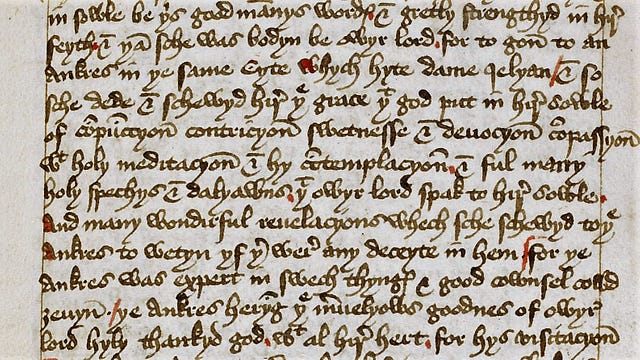
Lately I’m mostly reading books that relate to fourteenth-century England in one way or another, because that is the setting for my current WIP—the first of a projected mystery series called Seven Deadly Sins, featuring Julian of Norwich as a secondary character. The sleuth for the series is Matilda, a young woman who belongs to a lay order of quasi-monastics called Beguines. She serves as a scribe for Julian’s “showings” and often seeks her advice. Matilda’s uncle is the local crowner (coroner), and scribing for him gives her an excuse to be involved with crime.
As part of this research I’m rereading an excellent mystery series by Margaret Frazer, the Sister Frevisse mysteries, which are set just a few decades later than mine. Her historical underpinnings are impeccable, so this reading is kind of a shortcut way to immerse myself in the period. +
About Katherine Bolger Hyde
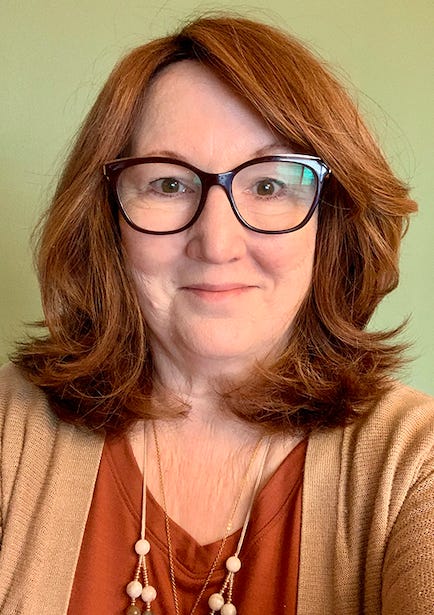
Katherine Bolger Hyde is the author of the Crime with the Classics traditional mystery series as well as several standalone novels, including The Vestibule of Heaven (Ancient Faith Publishing, 2024), and four children’s books. Her latest book is The Ghostwriter (Chrism Press, Aug. 2026). Katherine lives in the Pacific Northwest with her musician husband, John, and two vocal but sadly unmusical cats. When not writing, she can generally be found watching British detective shows while attempting to keep her knitting away from the aforementioned cats. You can learn more about her and her other books at kbhyde.com.
About The Ghostwriter, Katherine’s latest novel (coming August 2026, but available for pre-order now)
“Maeve O’Shaughnessy has been writing novels to great critical acclaim for twenty years without ever making a public appearance. But when her publisher insists she begin promoting her own books, Maeve, a recluse with anxiety disorder, cannot face such a terrifying ordeal. Instead, she recruits her identical twin, Margaret, to be her public persona.
Despite her misgivings, Margaret—recently divorced and in need of income—agrees. Problems quickly arise, from being recognized by acquaintances to falling in love with a man who hero-worships Maeve. With every talk or book signing, the line between her own personality and her sister’s blurs a little more. When Maeve is critically injured in a car accident, Margaret faces the most harrowing decision of all: Will she continue to live as Maeve, or will she take possession of her own life and become the woman she was always meant to be?” - from Chrism Press’s website
Thank you for reading this piece from Writing from the Desert Places. Please feel free to comment or share.
I love these interviews !